
Writen by
admin
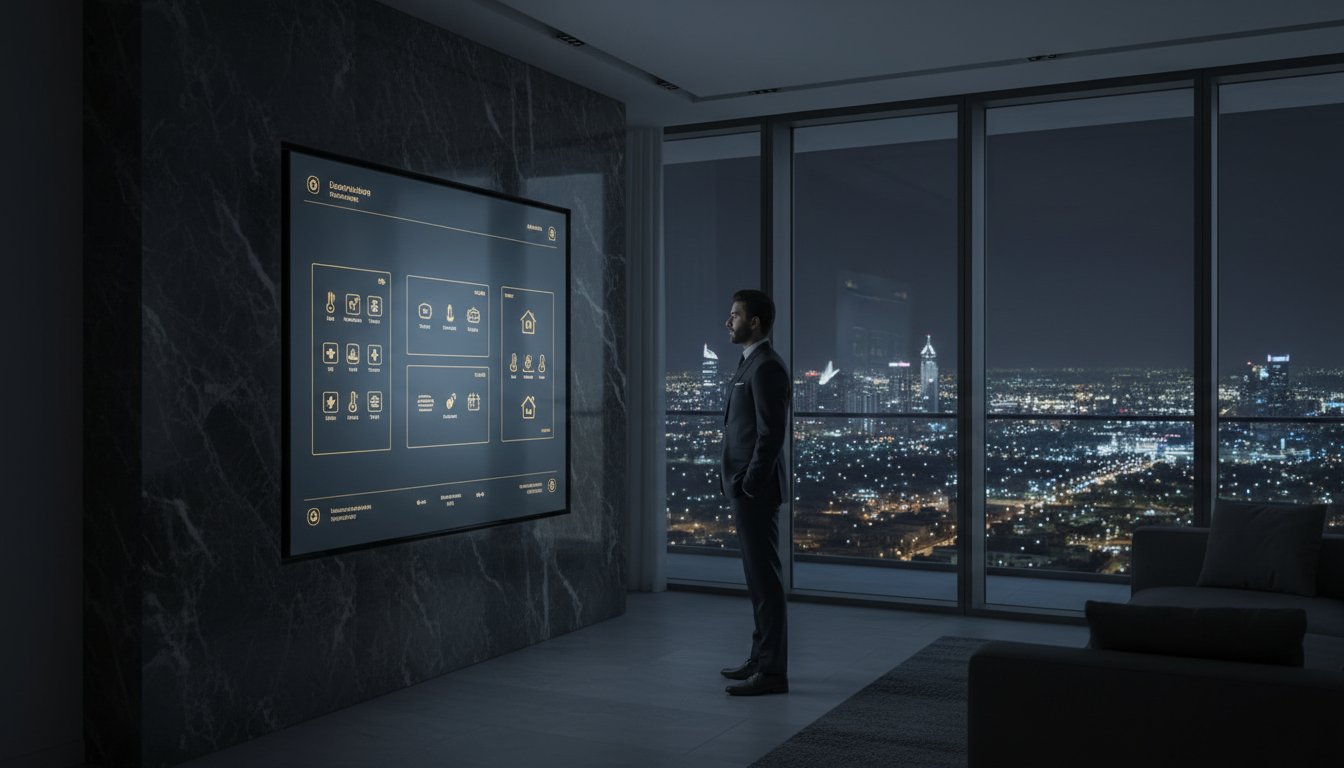
Your luxury residence isn’t truly “smart” if you’re still toggling between four different apps just to set the mood for dinner. In 2026, the real mark of a high-end property isn’t the number of gadgets you own, but how invisibly they work together. You likely agree that fragmented systems and Wi-Fi “dead zones” in a 5,000 square foot home turn a promise of convenience into a daily technical headache. It’s frustrating when a premium lighting setup drops off the network because of a weak router signal or a software conflict.
This guide will show you how to implement professional smart home solutions that replace this digital clutter with enterprise-grade reliability and a single, elegant interface. You’ll discover how to transform your property into a high-performance ecosystem designed for both luxury and total control. We’ll explore the latest in unified control systems, 10Gbps networking requirements for modern residences, and how integrated automation can slash your annual energy bills by 22% through AI-driven climate management.
 Ready to upgrade your living space? Contact Ziotech today to schedule your professional site survey and start building a smarter, more efficient home in the UAE.
Key Takeaways
- Learn how to transition from disjointed gadgets to a unified, professionally managed ecosystem that acts as the intelligent brain of your UAE property.
- Identify the four essential pillars of automation that maximize lifestyle impact and property ROI through custom-designed “scenes” like Movie Night or Away mode.
- Understand why bespoke smart home solutions offer superior data privacy and long-term reliability compared to off-the-shelf DIY products in luxury residences.
- Discover why an enterprise-grade “invisible backbone” is the most critical infrastructure investment for a high-performance, future-proof smart home.
- Explore the professional engineering and commissioning process required to deliver a seamless, high-performance technology experience tailored to the 2026 landscape.
What are Integrated Smart Home Solutions?
The modern residence in Dubai or Abu Dhabi has moved past owning a few voice-activated speakers. Today, What are Integrated Smart Home Solutions? represents a shift from disconnected gadgets to a unified, professionally managed ecosystem. Smart home solutions are a centralised technology framework that automates environment and security. This framework uses a central controller to act as the primary brain of the property. It manages the flow of data between devices to ensure they work in harmony.
Professional integration focuses heavily on interoperability. This means your lighting, climate, and security systems work as one unit. If a smoke detector triggers, the system doesn’t just beep. It automatically turns on all lights, unlocks the main door, and shuts down the AC to prevent smoke circulation. This level of coordination is only possible when a single controller manages every protocol, from Zigbee and Z-Wave to hardwired KNX systems.
The Difference Between Smart and Automated
Smart devices require you to open an app or give a voice command. It’s manual interaction. You’re still the one making the decision. Automated systems use logic to respond to sensors, time of day, or specific habits. True luxury in a 5,000 square foot penthouse lies in automation that requires zero user input. If the curtains close because the sun hit a specific angle at 2:00 PM, that’s automation. If you have to tell your phone to close them, it’s just a remote control. Advanced smart home solutions anticipate needs, adjusting the water heater thirty minutes before your usual morning routine begins.
Why National Property Owners are Upgrading in 2026
Property developers in the UAE are targeting a 12% to 15% increase in valuation by securing “smart-ready” certifications during the construction phase. In a climate where summer temperatures regularly hit 48 degrees Celsius, sustainable energy management is the top priority for 70% of new buyers. Automated cooling systems can reduce monthly DEWA bills by 22% through precision occupancy sensing and thermal load balancing.
By 2026, enhanced security like AI-driven facial recognition and biometric gates will be standard in 85% of luxury villa communities in Saadiyat Island and Emirates Hills. Owners are currently investing upwards of AED 75,000 into these systems to future-proof their assets. This investment ensures the property remains competitive in a market that increasingly views high-tech integration as a baseline requirement rather than an optional upgrade.
The Four Pillars of a Premium Smart Home Ecosystem
A truly sophisticated apartment doesn’t just feature isolated gadgets; it functions as a unified environment. High-end smart home solutions focus on four core pillars: lighting, climate, entertainment, and security. When these systems communicate through a brand-agnostic processor, they create a seamless lifestyle. A 2023 study of Dubai’s real estate market indicated that properties with fully integrated automation see a valuation increase of 5% to 7% over standard units. This ROI stems from the synergy between systems. For example, your home can trigger a “Movie Night” scene that dims the lights, lowers the blackouts, and sets the AC to a crisp 21°C with a single command.Intelligent Lighting and Shading
Lighting is the most immediate way to alter the mood of a space. Circadian rhythm programming adjusts the color temperature throughout the day. It mimics natural sunlight with 5000K cool whites at noon and shifts to 2700K warm tones by evening to support your sleep cycle. In the UAE, motorized shading is vital for more than just privacy. These systems block 95% of UV rays, protecting your bespoke furniture from sun damage. By replacing cluttered banks of plastic switches with a single, elegant keypad, you eliminate “wall acne” and gain intuitive control over every light source in the room.Climate Control and Energy Management
In a region where air conditioning can account for up to 70% of a household’s summer electricity bill, intelligent climate control is a financial necessity. Smart HVAC integration allows for zone-based cooling, meaning you only chill the rooms you’re actually using. Occupancy sensors can detect when a bedroom is empty for more than 30 minutes and automatically adjust the set point to save energy. Modern systems in Dubai are now frequently linked to solar arrays, allowing residents to monitor real-time generation and consumption. This level of oversight often results in a 20% reduction in monthly utility costs.Entertainment and Audio-Visual Integration
The latest trend in luxury apartments is the “invisible” home. High-fidelity speakers are now installed behind plasterboard or integrated into ceilings, providing 360-degree sound without a single wire in sight. Multi-room video distribution means you can watch 4K content from a central server on any screen in the house. Many owners are ditching dedicated cinema rooms for flexible “Media Rooms” that utilize ambient light-rejecting screens. If you’re looking to upgrade your living experience, you can find tailored smart home solutions that blend perfectly with your interior design. These systems ensure your technology serves your lifestyle rather than dictating your room’s layout.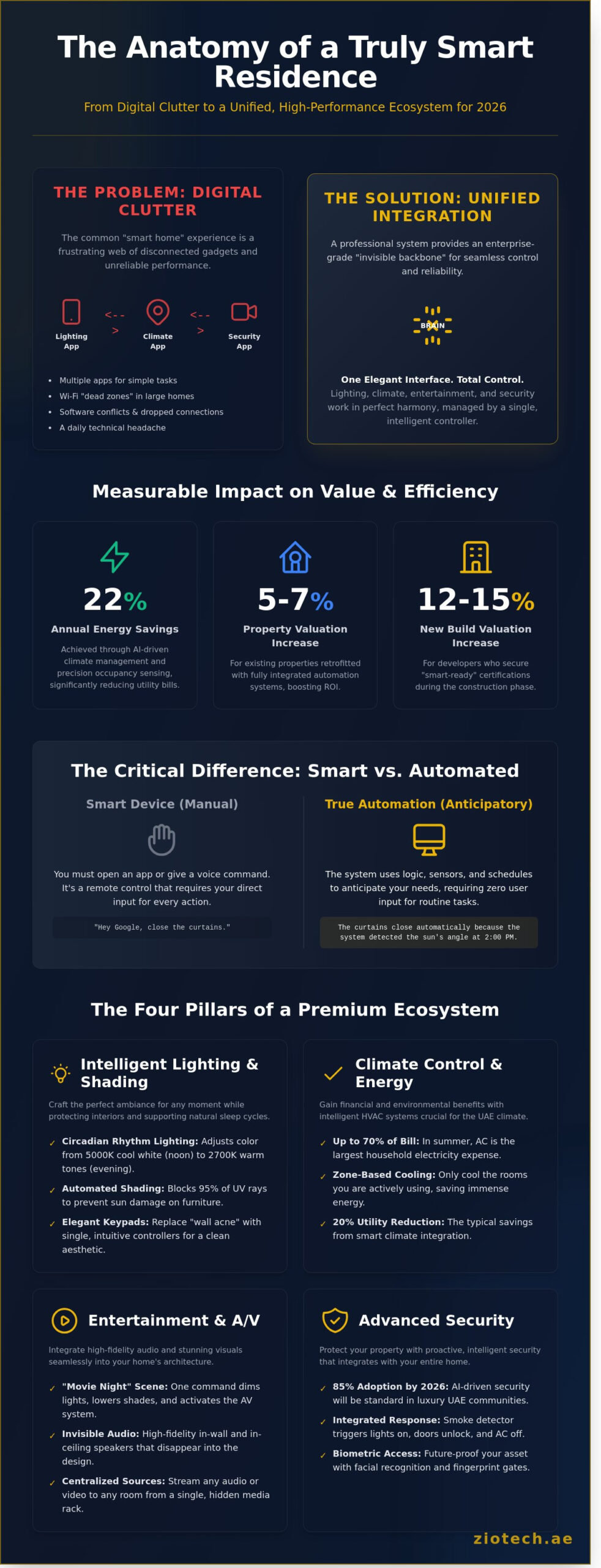
Professional Integration vs. DIY Smart Gadgets
Choosing between a DIY kit and a professional installation isn’t just about the initial price tag. It’s about how the system handles the unique environment of a UAE high-rise. Off-the-shelf products frequently fail in large-scale properties because they rely on congested 2.4GHz Wi-Fi bands found in dense buildings like those in Jumeirah Park or Downtown Dubai. Professional smart home solutions use dedicated frequencies or hardwired KNX backbones to ensure signals pass through thick concrete walls without interference. Security is another major differentiator. DIY gadgets often create a “Privacy Gap” because they rely on external cloud servers to process commands. This means your data travels outside your home, making it vulnerable to breaches. Professional systems prioritize local processing. Your data stays within your apartment, providing a level of security that meets the high expectations of UAE residents. While consumer gadgets often reach their end-of-life within 2 years due to planned obsolescence, professional systems offer a 10-year stability cycle that protects your investment. Reliability directly impacts the “Wife/Husband Acceptance Factor” (WAF/HAF). If a light fails to turn on because the internet is down, the system becomes a source of frustration rather than luxury. Professional systems are designed so that the core functions of the home, such as lighting and AC control, work 100% of the time, regardless of your internet connection status.The Power of Professional Programming
Platforms like Crestron and Control4 aren’t plug-and-play. They require certified engineers to program the logic that makes a home truly intelligent. Unlike consumer apps that offer limited “if-this-then-that” scenarios, professional programming allows for complex, multi-layered automation. For example, your system can adjust the AC to 22 degrees only if the balcony door is closed and the external temperature exceeds 35 degrees. This level of customization extends to the user interface, where buttons and touchscreens are tailored to match your interior design aesthetic perfectly.The Reliability Benchmark
The biggest weakness of DIY smart home solutions is their cloud dependency. If the manufacturer’s server goes offline, your home stops working. Professional hardware utilizes local processing, meaning your home remains fully functional even during an ISP outage. Every device undergoes a “handshaking” process during commissioning. This ensures that the intercom, shades, and media server communicate without errors. Professional systems also include hardware redundancy, which eliminates single points of failure that typically plague cheaper, consumer-grade setups.Designing a Future-Proof Smart Infrastructure
A high-performing smart home is only as reliable as the hidden network supporting it. Think of this infrastructure as the invisible backbone. In luxury UAE developments like the Palm Jumeirah or Downtown Dubai, a standard residence now averages over 50 connected devices. Relying on the basic router provided by your ISP often leads to system crashes. These units can’t manage the heavy data loads required for modern smart home solutions.Enterprise-Grade Networking
ISP-provided routers represent the primary cause of system failure in 90% of residential automation projects. To avoid this, we implement enterprise-grade hardware. Using VLANs (Virtual Local Area Networks) is critical. This technique segregates heavy traffic, such as 8K streaming, from essential security protocols. Professional access point placement is also vital for seamless roaming. In a 4,000 square foot apartment, strategic positioning ensures you never drop a signal while moving between rooms. While wireless tech improves, structured Cat6a cabling remains the gold standard for 2026. Hardwiring static devices reduces Wi-Fi interference by roughly 55%, leaving the airwaves clear for mobile devices.The Role of Annual Maintenance Contracts (AMC)
Smart technology requires consistent care to remain secure and functional. Software vulnerabilities emerge frequently, making firmware updates a necessity rather than an option. An Annual Maintenance Contract provides proactive health checks that keep your system stable. Many Dubai homeowners invest between 4,500 AED and 12,000 AED per year in professional AMCs to ensure 99.9% uptime. Remote monitoring tools allow our team to identify and fix glitches before they affect your daily routine. This approach protects your initial investment and ensures the system grows as new technology enters the market.To ensure your property is ready for the next decade of innovation, consult with our infrastructure experts today.
Implementing Bespoke Solutions with Ziotech
Ziotech brings 26 years of technical expertise to the United Arab Emirates technology market, ensuring that smart home solutions integrate seamlessly into high-end properties. Our process moves through a rigorous cycle from initial engineering design to final commissioning. We specialize in luxury residential projects where standard retail hardware fails to meet performance expectations. Our team manages professional programming and offers comprehensive Annual Maintenance Contracts (AMCs) starting at approximately 3,500 AED per year for premium support. This proactive service ensures your technology remains functional and secure long after the initial installation.Our Engineering-First Approach
We treat technology as a core utility, similar to plumbing or electricity. Our engineers design bespoke system architectures that align with specific architectural constraints of Dubai’s luxury towers. We collaborate with interior designers to conceal hardware, ensuring your aesthetic remains clean. Every project includes 100% accurate “As-Built” drawings. These documents detail every cable run and connection point; they’re vital for any future upgrades or troubleshooting in complex apartment layouts.Start Your Smart Journey
Engaging our team during the shell-and-core stage or early renovation phases prevents costly rework. A typical site survey in Dubai or Abu Dhabi identifies potential signal interference or wiring bottlenecks before they become expensive problems. You can book a professional design consultation to see how integrated smart home solutions enhance your daily lifestyle. Our experts focus on high-performance living, delivering systems that work every time you walk through the door.- Phase 1: Initial site survey and requirements gathering.
- Phase 2: Engineering design and schematic creation.
- Phase 3: Professional installation and system programming.
- Phase 4: Final commissioning and client training.
- Phase 5: Long-term support through tailored AMC packages.
Step Into the Future of UAE Living
Building a truly automated residence in 2026 requires moving beyond simple plug-and-play gadgets. High-performance villas in Dubai and Abu Dhabi now require enterprise-grade networking to manage the 100+ connected devices essential for modern comfort. By prioritizing professional integration over fragmented DIY setups, you ensure your property remains a functional, high-value asset for years to come. These bespoke smart home solutions provide the seamless reliability that only a unified ecosystem can offer. Ziotech leverages 25+ years of industry experience to deliver world-class automation across the United Arab Emirates. As certified Crestron and Control4 integrators, we specialize in enterprise-grade networking specialists who understand the unique architectural demands of the region. We’ve spent over two decades refining our processes to ensure every installation meets the highest standards of reliability and performance. Don’t leave your comfort to chance when you can work with specialists who understand the local landscape. Book a Professional Smart Home Consultation with Ziotech to begin designing your bespoke ecosystem today. It’s time to experience a home that anticipates your needs before you even realize them.Frequently Asked Questions
Is a smart home system worth the investment for a rental property?
Yes, installing smart home solutions increases rental yields by approximately 5% to 8% in Dubai. Tenants in areas like Downtown or Dubai Marina often pay a premium for integrated security and climate control. These features reduce energy consumption by 20% on average, making the property more attractive to eco-conscious renters. You’ll likely see a full return on investment within 24 to 36 months through higher occupancy rates.Can I integrate my existing AC and lighting into a professional smart home system?
You can integrate existing AC units and lighting using retrofit modules or smart thermostats like Nest or Ecobee. Most Dubai apartments use centralized AC systems that connect via IR blasters or Wi-Fi bridges. Professional installers use Zigbee or Z-Wave protocols to link 95% of traditional switches to a central hub. This avoids the need for replacing every fixture while providing full mobile control through a single interface.What happens to my smart home if the internet goes down?
Your core automation still functions because professional systems operate on a local area network. While you’ll lose remote access via your smartphone, physical switches and pre-set schedules continue to work perfectly. Systems like Control4 or Savant process commands locally rather than in the cloud. This ensures 100% reliability for lighting and climate control even if your local ISP has a temporary outage or connection issue.How much does a professional smart home solution typically cost?
A basic professional smart home solution for a two-bedroom apartment starts at approximately AED 15,000. For a fully integrated system including motorized blinds, multi-room audio, and advanced security, prices range from AED 45,000 to AED 120,000. These figures include hardware, programming, and professional installation services. Maintenance packages usually add an extra 10% to the initial hardware cost annually for software updates and dedicated technical support.Are smart home systems secure against hacking and data breaches?
Professional systems are highly secure because they use AES-128 bit encryption and dedicated VPNs for remote access. Unlike cheap DIY gadgets, brands like Crestron undergo rigorous penetration testing to meet enterprise-grade standards. You can reduce risks by 99% by using a separate VLAN for your smart devices. Regular firmware updates provided by certified dealers ensure your system stays ahead of 2024 security threats and unauthorized access attempts.What is the difference between Control4, Crestron, and Savant?
Control4 is known for its user-friendly interface and supports over 14,000 third-party devices. Crestron offers the highest level of customization and is the standard for 5-star hotels and luxury mansions across the UAE. Savant focuses on a sleek Apple-based ecosystem and high-end audio-visual integration. While Control4 is more affordable for mid-range apartments, Crestron provides a bespoke solution that handles complex, large-scale automation tasks without any noticeable lag.How long does the installation of a full home automation system take?
Installation for a standard three-bedroom apartment typically takes between 3 and 7 business days. The first 2 days focus on hardware mounting and wiring, followed by 3 days of programming and intensive testing. For complex setups involving motorized curtains and multi-zone audio, the timeline might extend to 14 days. Your integrator will provide a specific project roadmap to ensure minimal disruption to your daily routine during the process.Do I need to rewire my entire house for smart home solutions?
You don’t need to rewire your entire apartment because modern wireless technologies like Zigbee and Wi-Fi 6 handle most communication. Retrofit solutions use your existing electrical backboxes to house smart modules without cutting into walls. About 85% of apartment upgrades in the UAE now use these wireless or hybrid systems. This approach saves you roughly AED 10,000 in civil works and painting costs during the installation process.