
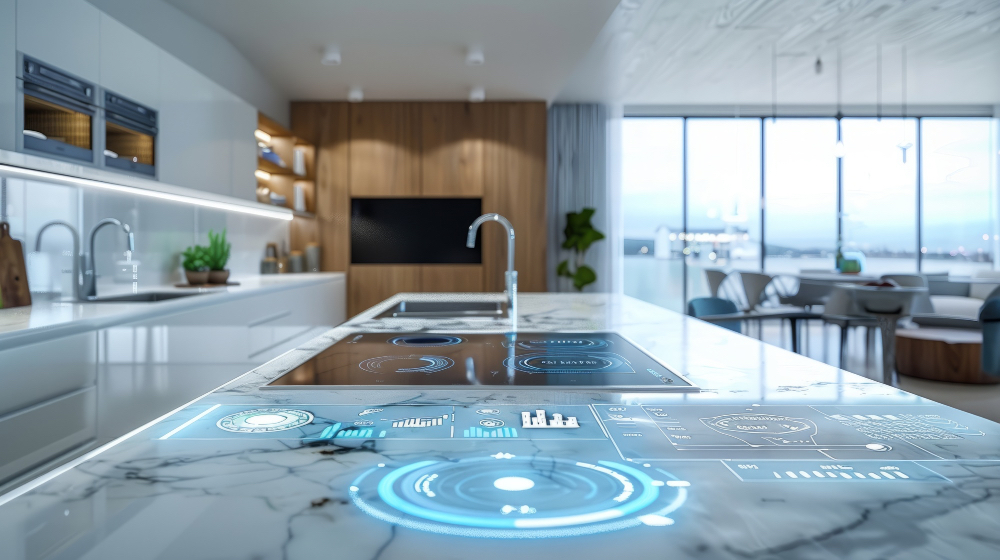
Most Dubai homeowners understand what a home automation system does — lights respond, temperature adjusts, scenes activate. Far fewer understand how it works. And that understanding matters: knowing the difference between a wireless sensor and a hardwired KNX module, or between a cloud-dependent app and a local-network-controlled system, helps you make better decisions when specifying a system, evaluating a proposal, or troubleshooting a fault.
This guide explains the technical architecture of a professional home automation system as installed in Dubai villas and apartments — the hardware layers, the control protocols, the networking infrastructure, and what happens inside the system when you press a single button on a keypad.
The Three-Layer Architecture of a Home Automation System
Every professional home automation system — regardless of the platform (Control4, Crestron, KNX, HDL) — is built on the same three-layer architecture.
Layer 1 — The Field Layer (Devices and Sensors)
The field layer is every physical device the system controls or monitors: lighting circuits, HVAC units, motorised blind motors, door locks, speakers, CCTV cameras, motion sensors, occupancy sensors, door contact sensors, temperature sensors, and AV equipment. These are the “things” — the hardware embedded throughout the property.
In a professional installation, field layer devices are either hardwired (wired directly into the control network via structured cabling) or wireless (communicating via a secure radio protocol like Z-Wave, Zigbee, or Control4’s proprietary wireless). Hardwired is always preferred for reliability and speed — wireless is used where running new cable is not practical.
Layer 2 — The Control Layer (The Brain)
The control layer is the automation controller — the central processor that receives inputs from field layer devices, executes the programmed logic, and sends commands back to field devices. In a Control4 system, this is the EA controller. In a Crestron system, it is the 3-Series or 4-Series processor. In a KNX system, it is a combination of the KNX bus and logic controllers.
The controller runs continuously, monitoring all connected devices and executing automation logic in real time. It does not need the internet to function — all core automation runs locally on the controller hardware. This is why a professional system continues operating during an internet outage, unlike consumer smart home products that depend on cloud servers.
Layer 3 — The User Interface Layer
The user interface layer is how the homeowner interacts with the system: keypads, touchscreen panels, mobile apps, voice controllers (Alexa, Google Home, Siri), and automated triggers (time-based, sensor-based, geofence-based). The user interface sends commands to the control layer, which interprets them and instructs the field devices accordingly.
Control Protocols Used in Dubai Home Automation Systems
The control protocol is the language devices use to communicate with the controller. Different protocols have different characteristics — understanding them helps explain why some systems are more reliable than others.
KNX — The Open Wired Standard
KNX is the most widely used wired automation protocol in UAE construction — specified by architects and MEP consultants on new-build villas and commercial buildings. KNX devices communicate over a dedicated 2-wire bus cable installed throughout the property. Every KNX device has its own address on the bus and can send and receive commands independently.
KNX’s key advantage is its open-protocol, manufacturer-agnostic nature — devices from Schneider, ABB, Siemens, Gira, and hundreds of other manufacturers all communicate on the same bus. It is also certified to EN 50090 and ISO/IEC 14543-3 — the same standards used in commercial building management systems. KNX installations are common in luxury villa automation projects across Dubai.
Control4 SDDP and SR Protocol
Control4 uses a combination of proprietary protocols for device communication — including ZigBee-based wireless (for Control4 wireless devices), TCP/IP (for network-connected devices), and serial/IR (for AV equipment). The Control4 controller acts as the central hub, translating between all of these protocols to create a unified control experience.
BACnet and Modbus — HVAC Integration
Dubai villas and apartments typically use centralised HVAC systems (ducted AC, VRF/VRV systems) that communicate via BACnet or Modbus protocols. A professional automation system integrates with these via protocol gateways — allowing the automation controller to read thermostat data, occupancy status, and energy consumption, and to send set-point commands to individual air handling units.
RS-232, RS-485, and IP — AV Control
AV equipment (projectors, amplifiers, AV receivers, matrix switches) is controlled via serial (RS-232, RS-485) or IP connections. The automation controller sends text commands to AV equipment — “power on”, “input HDMI 2”, “volume 35” — which the equipment interprets and executes. This is how pressing “Cinema” on a keypad can power on a projector, select the correct input, set the amplifier to surround sound mode, and dim the room lights simultaneously. See our home theatre solutions for how this works in practice.
Networking Infrastructure — The Foundation of a Reliable System
A professional home automation system depends on a well-designed network infrastructure. This is one of the most commonly underestimated aspects of automation in Dubai properties — and one of the most common causes of unreliable performance.
Structured Cabling
Every professional automation installation includes structured cabling — Cat6 or Cat6A ethernet cabling run to every device location, terminating at a central network rack. In a luxury villa, this means 30–100+ ethernet drops depending on property size. All cables are labelled, tested, and documented.
Network Segmentation
A professional automation network is segmented — separate VLANs (Virtual Local Area Networks) for automation control, AV distribution, security cameras, and guest Wi-Fi. This ensures that heavy video traffic from CCTV cameras does not interfere with real-time lighting and HVAC commands. It also provides security isolation — guest devices on the guest Wi-Fi cannot access the automation control network.
Managed Network Switches
Consumer-grade routers and unmanaged switches are not suitable for professional automation. A correctly installed system uses managed switches — typically from Cisco, Pakedge, or Araknis — that allow VLAN configuration, QoS (Quality of Service) prioritisation for real-time control traffic, and remote monitoring.
Wi-Fi Coverage
Enterprise-grade Wi-Fi access points (Cisco Meraki, Ubiquiti UniFi, Araknis) are specified for whole-property wireless coverage — including outdoor areas, basements, and pool decks. Consumer Wi-Fi routers with range extenders are not reliable for automation use — they create roaming issues and coverage dead zones.
How a Scene Actually Works — Step by Step
When you press “Leaving Home” on a keypad or the app, here is exactly what happens inside a Control4 system in a Dubai villa:
- Input received: The keypad button press sends a command over the local network (or KNX bus) to the Control4 EA controller — taking approximately 20 milliseconds.
- Logic executed: The controller looks up the “Leaving Home” scene in its programming — a list of commands to execute in sequence.
- Lighting commands sent: The controller sends commands to all lighting circuits via the Lutron processor or KNX lighting modules — all lights turn off. Response time: 100–200ms.
- HVAC command sent: The controller sends a set-point change to the BACnet gateway — all AC zones switch to 28°C economy mode. Response time: 1–2 seconds (HVAC systems respond slower than lighting).
- Blind commands sent: Motorised blind controllers receive close commands — blinds begin closing. Full travel time: 20–45 seconds depending on blind size.
- AV power-off sent: Serial commands sent to all AV equipment — TVs, amplifiers, and sources power off.
- Lock command sent: The door lock module receives a lock command via IP or RS-485 — front door locks within 1 second.
- Alarm arm command sent: The alarm panel receives an arm command via IP integration — alarm arms in exit delay mode.
- Status confirmed: The controller logs the scene execution and updates the app — you can see “Away” status from anywhere in the world.
Total execution time from button press to all commands sent: under 3 seconds. The blinds continue moving for up to 45 seconds — the only visible part of the process.
Local Processing vs Cloud Dependency — Why It Matters in Dubai
Consumer smart home products — Amazon Alexa routines, Google Home automations, Philips Hue scenes — depend on cloud servers. When the internet connection drops (or when the manufacturer’s server is offline), these automations stop working. In a Dubai villa during a Etisalat or du outage, the entire consumer smart home can become unresponsive.
Professional automation systems process all core logic locally on the controller hardware. The internet is only needed for remote access — controlling your home from abroad, receiving security alerts, or using cloud-dependent integrations. The local control system — all scenes, all lighting, all HVAC, all security — continues operating normally during an internet outage.
This is a fundamental reliability advantage that professional systems have over consumer products — and one of the primary reasons UAE homeowners who have experienced consumer smart home frustrations upgrade to professionally installed home automation systems.
Programming — How the System Learns Your Home
Hardware installation is only the first half of an automation project. Programming is where the system is taught how the property works — and it is the most skilled and time-intensive part of any professional installation.
A Control4 or Crestron programmer defines every automation rule, every scene trigger, every conditional — in proprietary programming software that requires manufacturer certification to access. Programming a luxury villa project typically takes 2–4 weeks of engineer time.
Key programming elements include:
- Scene definitions — which devices respond to which commands, in which sequence, with which parameters
- Schedule triggers — what time-based automations run daily, weekly, or seasonally
- Conditional logic — “If the occupancy sensor detects no presence for 20 minutes AND it’s after 10pm, turn off all lights in that zone”
- User permissions — which users can access which functions; guest mode; domestic staff access restrictions
- AV routing — which sources appear on which displays, input switching logic, volume limits per zone
- Security integration — when the alarm arms, what the automation system does; when a doorbell rings, which screens receive the notification
What to Ask About a Home Automation System Proposal
When evaluating a proposal for a home automation system in Dubai, the technical specification should answer these questions:
- Which control protocol is being used — and why is it right for this property?
- Is the system local-processing or cloud-dependent?
- What network infrastructure is included — managed switches, enterprise Wi-Fi, VLANs?
- How is the HVAC system integrated — BACnet, Modbus, or IR only?
- What programming language/platform is used, and does the installer have manufacturer certification?
- Is the system registered to my account or the installer’s account?
A professional home automation company in Dubai will answer every one of these in the written system design document — before installation begins.
Frequently Asked Questions — Home Automation Systems in Dubai
What is the difference between KNX and Control4 for a Dubai villa?
KNX is an open-protocol wired bus system — highly reliable, manufacturer-agnostic, and widely used in UAE new-build specifications. Control4 is a proprietary platform that acts as a central controller, integrating multiple protocols (KNX, IP, serial, ZigBee) into a unified interface. Many Dubai villa projects use both: KNX for the wired field layer infrastructure, Control4 as the control and user interface layer. They complement each other well.
Does a home automation system in Dubai work without the internet?
Yes — professional systems process all core automation locally. Lighting scenes, HVAC control, blind schedules, and security integration all run on the local controller. Internet is only needed for remote access from outside the property. Consumer products like Amazon Echo and Google Home are cloud-dependent and lose functionality without internet.
How many network points does a Dubai villa automation system need?
A typical 5-bedroom villa project requires 40–80 ethernet drops, depending on the number of automation devices, AV locations, and CCTV cameras. A large luxury villa can require 100+ drops. All runs should be Cat6A and terminate in a structured cabling patch panel in the network rack — not consumer-grade equipment.
What happens if the automation controller fails?
In a KNX system, devices can be controlled locally from their own keypads even if the controller fails — KNX is distributed by design. In Control4 and Crestron systems, field devices revert to basic standalone operation. Lighting returns to manual switch control; HVAC operates on its own thermostat. The automation scenes and scenes stop working until the controller is repaired or replaced — typically within 24–48 hours under an AMC agreement with a professional home automation company in Dubai.
Can a home automation system in Dubai be expanded after installation?
Yes — scalability is a core design requirement for professional systems. Adding zones, devices, or new integrations is part of normal system evolution. The network infrastructure should be designed with spare capacity. KNX bus systems can be expanded with additional devices at any time. Control4 controllers can be upgraded to handle larger device counts. A well-designed system from day one should accommodate 20–30% expansion without structural changes.
How is smart security integrated with the home automation system?
Smart security systems — alarm panels, CCTV, video intercoms, smart locks — integrate via IP, serial, or dedicated integration modules. The automation controller receives status updates from the alarm panel (armed, disarmed, zone triggered) and can trigger automation responses: lights flash when alarm triggers, CCTV recording starts when motion is detected, intercom calls appear on all touchscreens when someone rings the doorbell.
What is the difference between a managed and unmanaged network switch for automation?
An unmanaged switch forwards all traffic to all ports — no configuration possible, no QoS, no VLANs. A managed switch allows VLAN segmentation (separating automation, security, and guest traffic), QoS prioritisation (ensuring real-time control commands are never delayed by video traffic), and remote monitoring. Professional automation always uses managed switches — consumer routers are not suitable for automation networking.
How does whole-home audio distribution work technically?
Whole-home audio uses an audio matrix or distributed audio processor — typically from Sonos, Control4 Audio, or Crestron — to route audio sources (music streaming, TV audio, intercom) to speakers in different zones. Each zone has an amplifier channel and an in-ceiling or in-wall speaker pair. The automation controller sends commands to the audio matrix to select sources per zone, adjust volume, and trigger music as part of scenes. Our home theatre and audio team designs and installs all audio distribution systems.
Can AV integration be added to an existing automation system?
Yes — AV integration is one of the most common additions to existing automation systems in Dubai. If the property already has a Control4 or Crestron system, adding AV integration involves adding the AV equipment to the existing controller’s programming — no new controller required. Network cabling to AV rack locations is the main infrastructure requirement. In retrofit projects without existing AV cabling, wireless audio distribution (Sonos) can be used as an alternative.
What documentation should I receive after a home automation installation?
A professional installation should include: a full as-built cabling schedule, network diagram, device address list, scene programming document, user manual, system access credentials (registered to your account), and AMC agreement. If a company does not provide this documentation, you have no way to engage another service provider if needed. Always confirm documentation is included in the proposal before signing.
