
Published: | By: Zio Technologies Engineering Team
You have probably read that smart home automation can reduce your DEWA bill by 20–40%. That figure appears on almost every home automation website in the UAE, including ours. But a percentage on its own answers only half the question.
The other half — how does it happen, which systems drive the saving, how much does each one contribute, and when does the investment pay itself back — is what this guide covers.
This is not a guide to home automation in general. If you want an overview of what smart home systems cover and what they cost, our home automation service page covers that. This page is specifically about the DEWA bill — the mechanics behind the savings, the numbers that matter, and a real project scenario so you can assess what is realistic for your own property.
How DEWA Tariffs Work — and Why They Make Automation More Valuable Than You Think
Most Dubai homeowners know their DEWA bill is high in summer. Fewer understand the structure that makes it high — and why that structure amplifies the financial return from automation.
DEWA charges residential electricity on a tiered (slab) tariff. The more you consume, the higher the rate per unit on your additional consumption. In 2026, the residential tariff structure for UAE nationals and expats is broadly structured as follows:
| Monthly Consumption (kWh) | Rate per kWh (fils) |
|---|---|
| First 2,000 kWh | 23 fils |
| 2,001 – 4,000 kWh | 28 fils |
| 4,001 – 6,000 kWh | 32 fils |
| Above 6,000 kWh | 38 fils |
Note: Tariff rates are subject to DEWA review. Check dewa.gov.ae for current published rates. The structure above reflects the tiered principle, which is the relevant factor for this analysis.
A fuel surcharge (varying quarterly based on gas prices) and a 5% municipality fee are applied on top of consumption charges.
Why Tiered Tariffs Make Automation More Effective
Here is the practical implication that every Dubai homeowner should understand:
A Dubai villa consuming 8,000 kWh in a peak summer month is paying 38 fils per kWh on the top 2,000 units — the most expensive slab. A 25% reduction in consumption — cutting from 8,000 to 6,000 kWh — eliminates the entire top slab. Every unit saved in the upper tiers is worth more than a unit saved in the lower tiers.
Automation targets the largest consumption sources first — primarily HVAC, which accounts for 60–70% of a Dubai villa's electricity use. Reducing HVAC consumption by 25–30% in a high-consuming property does not just save proportional money — it drops the property out of the most expensive pricing tier entirely, multiplying the financial benefit.
This is why the savings percentage understates the AED impact for high-bill properties. A 25% consumption reduction on a villa with an AED 18,000 summer bill saves more than 25% of AED 18,000 — because the saved units were in the most expensive consumption band.
System-by-System Savings: How the 20–35% Builds Up
The overall savings figure is a stack of contributions from individual systems. Here is how each system contributes, and in what proportion, based on projects Zio Technologies has commissioned across Dubai villas.
1. HVAC Automation — The Largest Driver (15–22% of total bill)
Air conditioning accounts for 60–70% of electricity consumption in a Dubai villa. It is therefore the single highest-leverage system for bill reduction. A properly programmed HVAC automation strategy delivers savings through four mechanisms:
- Zone-based occupancy control: Each room's fan coil unit or split unit runs only when the room is occupied. In a 5-bedroom villa where 3 bedrooms are typically empty during the day, running those 3 units at a setback temperature (28–29°C) rather than full cooling (22–23°C) eliminates a large fraction of wasted cooling load. Based on monitored projects, this alone accounts for 12–18% of total electricity saving.
- Pre-cooling schedules instead of continuous cooling: Many Dubai homeowners run AC continuously at low temperatures to ensure the property is always cool. A smarter approach is to identify the times the property is occupied and pre-cool 45–60 minutes before arrival rather than cooling continuously. A villa empty from 8am to 6pm running pre-cool from 5pm uses a fraction of the continuous-cooling energy for the same arrival comfort.
- Away mode and geofencing: When the last household member leaves, the automation system switches all zones to economy setpoint (28°C) automatically. When the homeowner's phone is detected approaching the property, the system begins pre-cooling before arrival. No manual switching required, no forgotten AC left running.
- Night setback: At 11pm, bedroom setpoints shift from 22°C to 24–25°C — the human body requires less cooling during sleep. Multiplied across all bedrooms over 8 hours, this is a meaningful nightly reduction.
Typical HVAC automation contribution to total bill reduction: 15–22%
2. Automated Blind and Curtain Control — The HVAC Multiplier (4–8% of total bill)
Motorised blinds integrated with the automation system do not save electricity directly. They reduce the heat entering the building, which reduces the cooling load, which reduces the electricity the HVAC system needs to maintain setpoint. This makes blind automation a multiplier on HVAC savings rather than an independent saving.
In a Dubai villa with west and south-facing glazing, solar heat gain through unshaded glass on a July afternoon is substantial. A window facing west at 3pm in Dubai receives approximately 750–900 W/m² of direct solar radiation. Automated blinds that close at 11am on south-facing glazing and 1pm on west-facing glazing — based on real-time solar position data — intercept this heat before it enters the building and loads the AC system.
The result: the AC system maintains setpoint at lower output, running fewer compressor cycles and consuming less electricity. Across a full summer month, properly programmed blind automation contributes 4–8% of total electricity saving — delivered through reduced HVAC consumption rather than directly.
Typical blind automation contribution: 4–8% of total bill reduction
3. Lighting Control — Consistent but Smaller (2–5% of total bill)
Lighting control contributes real savings — but smaller than HVAC, because lighting accounts for only 10–15% of a Dubai villa's electricity consumption. The mechanisms are:
- Motion-triggered turn-off: Lights in utility rooms, bathrooms, corridors, and the garage turn off automatically after a period of no motion. The guest bathroom light left on all day by a child is turned off within 5 minutes.
- Daylight-linked dimming: Rooms with natural light are dimmed automatically when ambient light sensors detect sufficient daylight — artificial lighting supplements rather than duplicates natural light.
- Scheduled exterior lighting: Garden, facade, and pool lighting operates on astronomical schedules (activating at sunset, turning off at a set time) rather than running all night on a manual switch someone forgot to turn off.
- Away mode: All lights off when the property is empty — without relying on individual family members to switch off every room before leaving.
Lighting is also typically already efficient in newer Dubai properties (LED throughout), which caps the saving potential. The contribution is consistent but modest relative to HVAC.
Typical lighting automation contribution: 2–5% of total bill reduction
4. Pool and Garden Automation — Meaningful for Larger Properties (1–4% of total bill)
Pool pumps in Dubai villas typically run continuously or on basic timers — often longer than hydraulically necessary. An automated pool management system runs the pump on an optimised schedule based on actual pool usage, switching to a minimum circulation cycle overnight and during extended vacant periods. Pool heating and chilling is scheduled rather than continuous.
Irrigation systems connected to moisture sensors and weather data run only when the garden needs water — eliminating the programmed-but-not-needed watering cycle that runs regardless of the previous night's rain or soil moisture level. Water savings are distinct from electricity savings but appear on the same DEWA bill.
Typical pool and irrigation automation contribution: 1–4% of total bill reduction
Combined Stacked Saving
| System | Contribution to Total Bill Reduction | Primary Mechanism |
|---|---|---|
| HVAC automation | 15 – 22% | Zone control, schedules, away mode, night setback |
| Automated blind control | 4 – 8% | Solar heat gain reduction → reduced cooling load |
| Lighting control | 2 – 5% | Motion turn-off, daylight dimming, scheduling |
| Pool and irrigation | 1 – 4% | Optimised pump schedules, sensor-based irrigation |
| Total combined saving | 22 – 39% |
The range reflects variation in property size, occupancy patterns, and how well the previous (unautomated) habits managed energy. Properties with very poor existing habits — AC running continuously at 18°C in every room around the clock — see savings at the top of the range. Properties already managed carefully see savings at the lower end.
A Real Project Scenario: 4-Bedroom Villa in Dubai Hills Estate
The figures below are based on a Zio Technologies project: a 4-bedroom, 3,200 sq ft villa in Dubai Hills Estate, occupied by a family of four (two working adults, two school-age children). The villa was fully furnished and occupied before automation was installed — a retrofit project.
Pre-Automation Baseline (Peak Summer Month — July)
| Cost Item | Monthly Spend |
|---|---|
| DEWA electricity (approx. 6,800 kWh) | AED 9,200 |
| DEWA water | AED 480 |
| Municipality fee + fuel surcharge | AED 1,050 |
| Total July DEWA bill | AED 10,730 |
AC was running at 20–22°C continuously in all bedrooms and main living areas from approximately 7am to midnight. Guest bedroom ran continuously even when empty for weeks. Pool pump ran on a 12-hour continuous timer. Garden irrigation ran daily regardless of weather.
Post-Automation: Same Month, Following Year (July)
System installed: Control4 EA-3 controller, KNX lighting and blind actuators, BACnet HVAC integration across 9 fan coil units, 14-zone lighting control, motorised blinds on all main glazing, pool automation module, irrigation controller with soil moisture sensors.
Programming implemented:
- Weekday schedule: master bedroom and living areas remain at 23°C from 7–9am and 5–11pm; all other times setback to 27°C
- Guest bedroom: setback to 28°C unless manual override active
- South and west blinds close progressively from 10am based on solar sensor data
- Lighting: motion-triggered in bathrooms, utility, corridor; astronomical schedule for exterior
- Pool pump: reduced to 6-hour daily circulation plus demand-based boost
- Irrigation: soil moisture sensor — triggered only when moisture drops below threshold
- Away scene (geofence): all zones to 28°C, all lights off, pool pump to minimum
| Cost Item | Monthly Spend (Post-Automation) | Saving vs Baseline |
|---|---|---|
| DEWA electricity (approx. 4,900 kWh) | AED 6,350 | AED 2,850 |
| DEWA water | AED 290 | AED 190 |
| Municipality fee + fuel surcharge | AED 740 | AED 310 |
| Total July DEWA bill | AED 7,380 | AED 3,350 |
Monthly saving in peak month: AED 3,350 (31% reduction)
Winter months show smaller absolute savings (bills are lower) but a consistent percentage saving. Annualised, the saving across all 12 months comes to approximately AED 26,000–28,000 per year for this property.
Payback Calculation for This Project
| Total automation project cost (installed, programmed, commissioned) | AED 92,000 |
| Annual DEWA saving | AED 27,000 |
| Annual AMC cost | AED 6,500 |
| Net annual benefit after AMC | AED 20,500 |
| Payback period (energy savings only) | 4.5 years |
This payback calculation covers only DEWA savings. It does not include the lifestyle value of the system, the security improvements, the property value uplift, or the comfort benefit of a properly managed indoor climate. It is the conservative case — and on its own, a 4.5-year payback on an asset that will last 15–20 years with professional maintenance is a strong return.
For a larger villa with pre-automation bills above AED 15,000/month in summer, the same calculation produces a payback of 2–3 years.
Summer Peak Month Strategy: Programming for June to September
The four months from June through September account for a disproportionate share of annual DEWA spend in Dubai. Outdoor temperatures reach 43–47°C. Humidity peaks in July and August. The cooling load on a Dubai villa is at maximum and DEWA consumption is at its highest — which, given tiered tariffs, means the most expensive per-unit rates apply.
A properly programmed summer automation strategy addresses this specifically:
Pre-Dawn Pre-Cooling
The coolest period of a Dubai summer day is between 4am and 6am — outdoor temperatures drop to 30–34°C. A villa that pre-cools its thermal mass during this window (setting setpoints to 21°C between 4am and 6am, then allowing the temperature to drift to 24°C through the morning) uses this cooler period efficiently, reducing the compressor work required during the hottest midday hours. The same pre-cooled thermal mass keeps the property comfortable with less active cooling during the peak heat period.
Midday Heat Block
Between 12pm and 4pm in peak summer, the combination of high outdoor temperature and maximum solar radiation creates the heaviest cooling load of the day. The automation strategy for this window:
- All south and west blinds closed fully by 11am, maintained closed until 4pm
- HVAC setpoints raised to 24–25°C in unoccupied rooms during this period
- Pool pump shifted to minimum circulation during peak solar hours
- Outdoor lighting circuits disabled during daylight hours (prevents timer faults)
Evening Occupancy Preparation
Most Dubai families return home between 5pm and 7pm. The automation system begins pre-cooling 60–90 minutes before typical return time based on the household schedule — not running all day, but ready at the right moment. Geofencing on the homeowner's phone triggers pre-cooling if the schedule varies.
Night Setback Discipline
After 11pm, bedroom setpoints shift from 22–23°C to 24–25°C. Research consistently shows human sleep quality is not degraded at 24–25°C. The compressor load reduction across 7–8 hours of sleep for all bedrooms is substantial — multiplied across 120 nights of Dubai summer, this is a meaningful annual saving.
Apartments on District Cooling: How the Savings Work Differently
A significant number of Dubai's apartments — particularly in Downtown Dubai, Dubai Marina, Business Bay, Jumeirah Lake Towers, and DIFC — are connected to district cooling networks operated by Empower, Tabreed, or developer-managed plants. In these properties, the chiller that cools the building is operated centrally, and residents pay for cooling on a kRT (kilorefrigeration ton) consumption basis — separately from the DEWA electricity bill.
For apartment owners on district cooling:
- Smart home automation that controls fan coil units reduces the cooling energy consumed by the apartment
- This saving appears on the district cooling bill — not the DEWA electricity bill
- DEWA electricity savings in apartments on district cooling come primarily from lighting control, appliance management, and any non-cooling electrical loads
- The percentage saving on the combined utility spend (DEWA + district cooling) is comparable to a villa on DEWA cooling — but the saving is split across two bills
The automation strategy for an apartment on district cooling is the same: zone control, schedules, occupancy-based setback. The financial benefit is the same. Only the billing line it appears on differs.
DEWA Smart Meter Integration: Seeing and Acting on Real Consumption Data
DEWA has progressively rolled out smart meters across Dubai, providing real-time and interval consumption data accessible via the DEWA customer portal and API. A professionally installed home automation system can integrate with this data in two ways:
Monitoring and Visibility
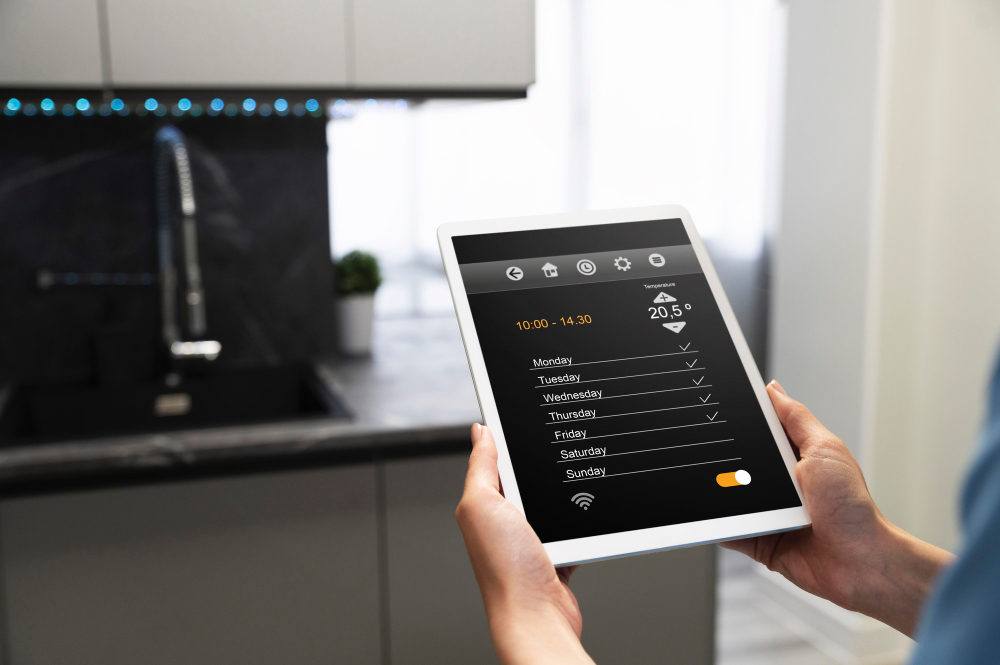
Real-time DEWA consumption data displayed on the home automation touch panel and mobile app. The homeowner sees current consumption in kWh, today's spend in AED, and this month's running total — updated in near real time. This visibility alone changes behaviour: homeowners who can see a spike in consumption when a guest bedroom AC is left running are more motivated to set the correct automation rules.
Consumption-Triggered Automation
In advanced configurations, the automation system can respond to consumption thresholds. If daily consumption exceeds a defined target by 2pm, the system automatically shifts all non-essential zones to economy setpoint for the remainder of the day. If monthly consumption is tracking above budget by mid-month, a notification is sent and the homeowner can approve a temporary efficiency mode. This is not a standard feature in every installation — but it is available on professional platforms and represents the next evolution of smart energy management in Dubai homes.
What Smart Home Automation Does Not Save On
An honest assessment of where automation does and does not deliver savings is more useful than overpromising across the board. These are the areas where automation has limited or no impact on the DEWA bill:
Appliance Standby Power
Smart plugs and energy monitoring sockets can switch appliances off at the socket to eliminate standby consumption. In a modern UAE home, standby power (TVs, chargers, routers, set-top boxes) typically amounts to 100–200W continuously — AED 200–400 per month. Automation can eliminate this but the saving is modest relative to HVAC. It is not a primary driver of bill reduction.
Inefficient Appliances
Automation optimises how and when appliances run — it does not change the efficiency of the appliance itself. An old, inefficient window AC unit that draws 3kW to deliver 1kW of cooling will continue to do so regardless of how cleverly it is scheduled. Appliance efficiency (moving to inverter-driven systems, upgrading old equipment) is a separate lever from automation and often delivers comparable savings.
High-Load Fixed Appliances
Ovens, washing machines, dishwashers, and other high-draw appliances that run for fixed durations cannot be meaningfully optimised by automation beyond shifting their run time to off-peak tariff periods (which DEWA's current residential tiered tariff does not incentivise by time of day — unlike some international utility structures). Automation scheduling of these loads is a convenience feature rather than a significant bill-reduction tool under the current DEWA residential tariff structure.
DEWA Water Charges (Except Irrigation)
Smart home automation has limited impact on water consumption inside the home — showers, taps, and cooking water use are not practically automatable. The exception is garden irrigation, where sensor-based control can reduce water consumption by 30–50%, delivering meaningful savings on the water portion of the DEWA bill. For a large garden in a Dubai Hills or Arabian Ranches villa, this is a worthwhile inclusion in scope.
Payback Period by Property Type: Quick Reference
| Property Type | Typical Peak Summer Bill | Estimated Annual Saving | Typical System Cost | Payback Period (Energy Only) |
|---|---|---|---|---|
| 2-bed apartment (DEWA) | AED 1,800 – AED 3,000/month | AED 5,000 – AED 9,000/year | AED 18,000 – AED 35,000 | 3 – 5 years |
| 3–4 bed villa | AED 6,000 – AED 12,000/month | AED 18,000 – AED 32,000/year | AED 55,000 – AED 95,000 | 3 – 5 years |
| 5–6 bed villa | AED 12,000 – AED 20,000/month | AED 32,000 – AED 55,000/year | AED 90,000 – AED 160,000 | 2.5 – 4 years |
| Large luxury villa | AED 20,000 – AED 50,000/month | AED 55,000 – AED 130,000/year | AED 150,000 – AED 350,000 | 2 – 3 years |
Payback periods above are calculated on energy savings alone, net of annual AMC cost. They do not include lifestyle value, security improvements, or property value uplift from a professionally installed smart home system.
For a detailed breakdown of what drives smart home system costs in Dubai, our home automation cost guide covers every component of a project budget.
Book a Free Energy Assessment for Your Dubai Property
Every Zio Technologies installation begins with a site survey that includes an assessment of your current DEWA bills, your occupancy patterns, and your property's specific energy profile. We will tell you clearly what saving is realistic for your property — not a generic percentage, but an estimated AED figure based on your actual bills and your villa's specific characteristics.
With 25 years of UAE installations and 1,000+ completed smart home projects across Dubai, our engineering team has the project data to give you an honest, evidence-based savings estimate before you commit to anything.
Book your free DEWA savings assessment →
Or explore what a complete smart home installation covers on our smart home solutions guide, and read about the systems that deliver the highest energy savings in our home automation systems guide.
Frequently Asked Questions — Reducing DEWA Bills with Smart Home Automation
How much can smart home automation realistically reduce a Dubai DEWA bill?
For a properly programmed professional smart home system in a Dubai villa, energy reductions of 20–35% are consistently achievable. The saving is larger in summer months (June–September) when bills are highest, and larger for properties with inefficient existing HVAC habits. The reduction comes primarily from HVAC optimisation, with additional contributions from automated blind control and lighting management. Properties with high pre-automation bills see the largest absolute AED savings due to DEWA's tiered tariff structure.
Does smart home automation affect the DEWA fuel surcharge?
Yes — indirectly. The DEWA fuel surcharge is applied as a multiplier on total consumption. Reducing consumption through automation reduces both the base electricity cost and the proportional fuel surcharge applied to it. The same applies to municipality fees, which are calculated as a percentage of electricity and water charges. Reducing consumption at the kWh level cascades through every consumption-based charge on the bill.
What is the payback period for a smart home system purely from DEWA savings?
For a mid-range Dubai villa with a summer DEWA bill of AED 8,000–12,000 per month, a professionally installed automation system costing AED 80,000–100,000 typically achieves payback in 3–5 years purely from energy savings. For a larger villa with bills above AED 15,000 per month, payback periods of 2–3 years are achievable. These calculations cover energy savings only and do not include lifestyle value, security benefits, or property value uplift.
Does smart home automation save on district cooling bills in Dubai apartments?
District cooling (Empower, Tabreed) is charged separately from DEWA electricity. Smart home automation that controls fan coil units reduces cooling energy consumed, which reduces the district cooling bill — but does not reduce DEWA electricity consumption for cooling specifically. For apartments on district cooling, automation savings appear on the cooling bill rather than the DEWA electricity bill. The principle and percentages are similar.
Can I integrate DEWA's smart meter with a home automation system?
Yes. DEWA smart meters support real-time consumption data accessible via API. A professional home automation system can display real-time and historical consumption data on touch panels and mobile apps. In advanced configurations, the system can trigger automation responses based on consumption thresholds — for example, switching HVAC zones to economy mode if daily consumption exceeds a defined target. This capability is available on Control4, KNX, and Crestron platforms.
