
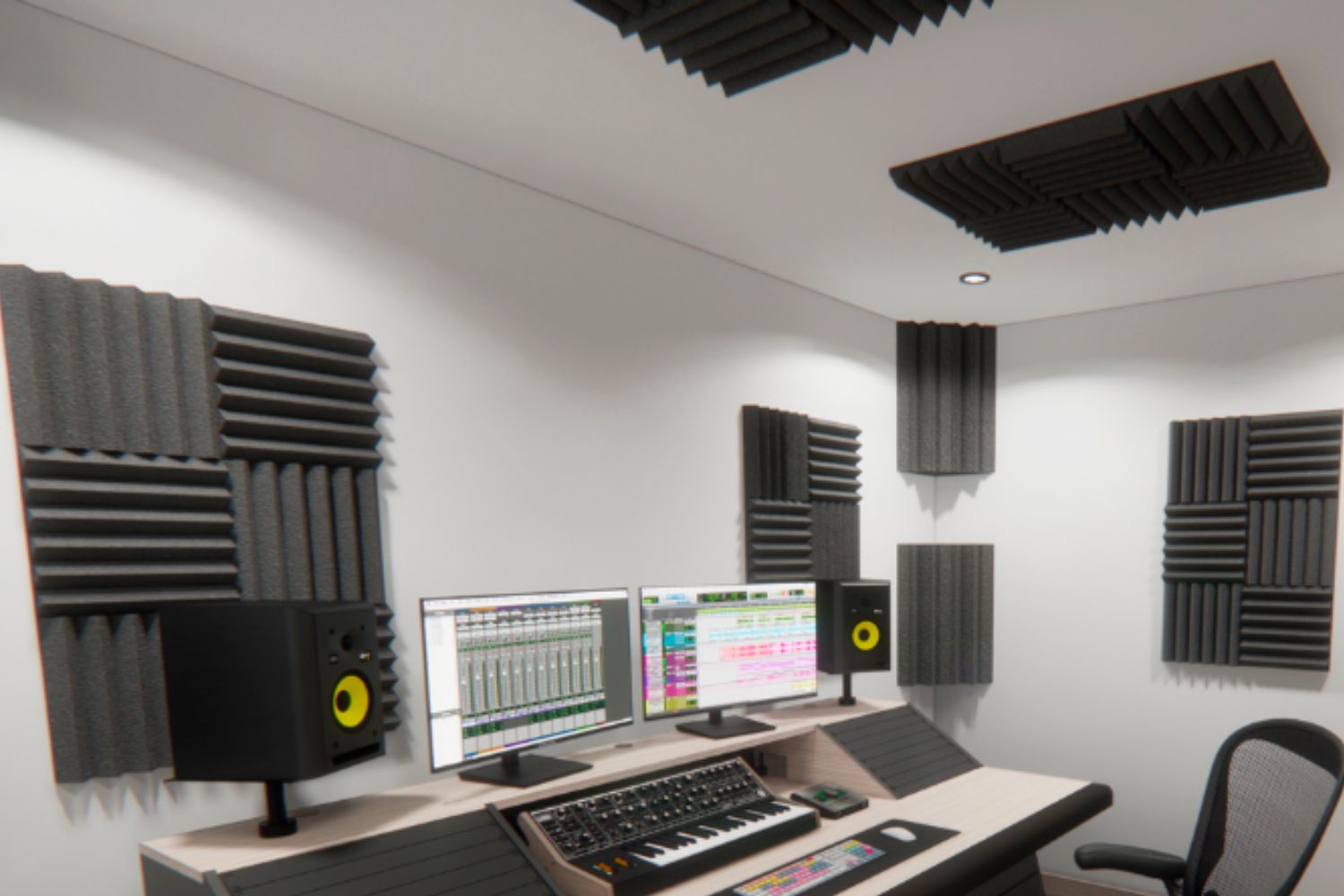
| Category: Home Cinema Solutions
A Dolby Atmos home cinema running at realistic playback levels produces sound pressure that travels through concrete slabs, stud walls, and solid doors with ease. Without proper structural isolation, your cinema disturbs every adjacent room in the property — and external noise from the rest of the house works its way back in, destroying immersion during quiet scenes.
Getting this right requires addressing something that most cinema buyers overlook until it is too late: the difference between soundproofing and acoustic treatment.
Soundproofing vs Acoustic Treatment: Understanding the Difference First
These two terms are frequently used interchangeably, and the confusion causes real problems on cinema room projects. They are entirely different disciplines.
| Soundproofing (Sound Isolation) | Acoustic Treatment | |
|---|---|---|
| What it does | Stops sound passing through walls, floors, and ceilings | Controls how sound behaves inside the room |
| Materials | Mass-loaded vinyl, double drywall, resilient channels, acoustic sealant | Fabric-wrapped panels, bass traps, diffusers |
| When it happens | During construction or major fit-out — before finishes | After the room is built — surface-applied |
| What happens without it | Sound escapes to adjacent rooms; outside noise enters | Echo, flutter, bass buildup, unclear dialogue |
Both are required for a properly performing cinema room. This guide covers soundproofing — the structural isolation work. For the acoustic treatment side, read the companion guide: Home Cinema Interior Design in Dubai: Acoustic Panels, Seating, Lighting & Materials .
Why Dubai Properties Present Specific Soundproofing Challenges
Dubai's residential construction uses reinforced concrete as the primary structural material — which sounds like an advantage for soundproofing, and in some ways it is. Concrete has high mass and blocks sound transmission better than timber frame construction common in Europe or North America.
However, Dubai properties present a different set of challenges:
Concrete Flanking Paths
Concrete transmits vibration — particularly low-frequency bass — very efficiently through its structure. In a villa where the cinema room shares a concrete slab floor with a bedroom above, bass from a subwoofer travels through the slab as structure-borne vibration and reconverts to airborne sound in the room above. Adding panels to the wall does nothing to address this. Only decoupling the floor from the slab breaks this path.
Apartment Construction
In high-rise apartments — particularly older builds in Dubai Marina, JLT, and Downtown — internal partition walls are typically lightweight blockwork or hollow block construction with minimal mass. These achieve an STC (Sound Transmission Class) rating of approximately 35–40. A Dolby Atmos system running at reference level needs walls rated at STC 60+ to contain its output. The gap between those two numbers represents a significant engineering challenge.
Shared Spaces in Villas
In Dubai villas, the home cinema is frequently positioned adjacent to a majlis, a guest bedroom, a staff room, or directly below a master suite. The proximity of these high-occupancy spaces to the cinema room makes isolation critical — not just for family comfort, but for the usability of the cinema itself during normal household activity.
HVAC Requirements
Dubai's climate means air conditioning is non-negotiable. HVAC ducting creates direct acoustic pathways between rooms — sound travels through ductwork with very little attenuation. This is one of the most commonly overlooked flanking paths in cinema room projects.
The Four Principles of Effective Sound Isolation
Professional soundproofing is built on four physical principles. Every technique described in this guide works by applying one or more of them:
1. Mass
Heavier materials are harder for sound waves to move. Doubling the mass of a wall increases its isolation by approximately 6 dB. Mass-loaded vinyl (MLV), additional layers of drywall, and dense concrete block all add mass to a partition.
2. Decoupling
Structure-borne vibration travels through rigid connections between surfaces. Breaking those connections — by floating a floor on resilient underlayment, mounting a ceiling on resilient channels, or building a wall on an isolated sole plate — stops vibration transferring between the cinema room structure and the surrounding building.
3. Damping
Constrained layer damping converts vibrational energy into heat by placing a viscoelastic compound — most commonly Green Glue — between two rigid layers (such as two sheets of drywall). This is particularly effective at mid frequencies and is one of the most cost-efficient soundproofing upgrades available.
4. Air Sealing
Sound travels through gaps with almost no resistance. A gap of 1mm around a light switch, a poorly sealed door frame, or an unsealed cable penetration can undermine thousands of dirhams of soundproofing work elsewhere. Every penetration in a soundproofed room — power sockets, data cables, HVAC connections — must be sealed with acoustic sealant.
Soundproofing Cinema Room Walls in Dubai
New Build or Full Renovation
The most effective wall construction for a cinema room is a double-leaf decoupled wall — two independent wall structures with an air gap between them and no rigid connection. This eliminates the primary structure-borne transmission path and, combined with mass and damping on each leaf, can achieve STC ratings above 65.
A typical specification for a high-performance cinema room wall in Dubai:
- Inner leaf: 2× layers of 15mm drywall with Green Glue between layers, mounted on isolated metal studs with no contact to the original wall
- Air gap: 50–100mm, optionally filled with dense mineral wool (not standard acoustic foam)
- Outer leaf: existing concrete or blockwork wall
- All perimeter joints sealed with acoustic sealant before any finishing
Retrofit in an Existing Room
Where full demolition is not possible, the most effective retrofit approach:
- Apply mass-loaded vinyl (MLV) directly to the existing wall surface
- Build an independent stud wall in front, floating it on resilient mounts at base and top — no rigid contact with the original wall or ceiling slab
- Double drywall with Green Glue on the inner face of the new stud wall
- Seal every electrical socket box, cable outlet, and perimeter joint with acoustic sealant
Retrofit always sacrifices some room area — a properly decoupled inner wall takes 100–150mm off each treated surface. In room planning terms, this must be factored into the layout before furniture or seating is specified.
Soundproofing Cinema Room Floors — The Most Important Surface in Dubai
In Dubai, the floor is often the most critical soundproofing surface — particularly in apartments or wherever a room exists directly below the cinema. Bass frequencies from a subwoofer couple directly into the concrete slab as impact and structure-borne vibration. This cannot be stopped by wall panels; only decoupling the floor from the slab addresses it.
Floating Floor Construction
A floating floor rests on a resilient underlayment rather than bonding directly to the concrete slab. The underlayment isolates the floor from the structure below, breaking the path for vibration transfer.
For a high-performance cinema room floor:
- Apply mass-loaded vinyl directly to the concrete slab as the first layer
- Install resilient neoprene or rubber isolation pads at regular intervals
- Lay a floating timber or MDF platform on the isolation pads — this platform must not touch any wall
- Finish with carpet over a dense rubber underlay (carpet is significantly more effective than hard floor finishes for sound isolation)
- Seal the perimeter gap between the floating floor and the wall base with acoustic sealant before fitting skirting
Subwoofer Placement and Isolation
Even with a floating floor, placing a subwoofer directly on the floor creates a direct coupling path. Isolating the subwoofer on dedicated isolation feet or a decoupled platform significantly reduces structure-borne transmission through the floor system.
Soundproofing the Cinema Room Ceiling
For ground-floor or basement cinema rooms in Dubai villas, the ceiling is critical — a bedroom above a cinema running at Dolby Atmos reference levels will receive significant low-frequency energy through an untreated concrete slab ceiling.
Resilient Channel Ceiling System
A resilient channel (or isolation clip) ceiling decouples the drywall surface from the concrete slab above using metal channels mounted on rubber isolation clips. The drywall hangs from the channels without any rigid connection to the structural ceiling.
Recommended construction for a cinema room ceiling in Dubai:
- Fix resilient sound isolation clips to the concrete slab at calculated spacing
- Hang metal hat channels from the clips
- Fill the resulting cavity with 75–100mm dense mineral wool
- Apply 2× layers of 15mm drywall with Green Glue between layers to the underside of the channels
- Seal all perimeter joints and any ceiling penetrations (recessed lights, speakers) with acoustic sealant
Important: Recessed ceiling speakers are a direct acoustic hole if not treated. In-ceiling speakers for a cinema room should be installed in sealed back-boxes that isolate the speaker cavity from the ceiling void above. This is a detail frequently omitted on cinema projects and one that causes significant sound leakage.
Acoustic Doors — The Weakest Point in Most Cinema Rooms
A standard hollow-core interior door achieves an STC rating of approximately 20–25. A wall constructed to STC 60 with a standard door in it performs at STC 25 — the weakest link determines the overall isolation. The door is almost always that weakest link.
Purpose-Built Acoustic Doors
Acoustic doors for cinema rooms are solid-core, heavily constructed, and fitted with compression seals on all four edges — top, both sides, and an automatic drop seal that engages at the threshold when the door closes. Properly specified acoustic doors achieve STC 45–55.
For the highest isolation requirements, a double-door vestibule (airlock) — two acoustic doors with a small lobby between them — is the most effective solution. Sound energy dissipates in the air gap between the two doors, achieving isolation levels that a single door cannot match.
Retrofitting an Existing Door Opening
Where budget or space prevents a full acoustic door installation:
- Replace the hollow-core door with a solid-core door as a minimum
- Apply acoustic door seals to all four edges — compression seals to sides and top, a drop seal to the base
- Seal any gaps between the door frame and the surrounding wall construction with acoustic sealant
A well-sealed solid-core door significantly outperforms an unsealed purpose-built acoustic door — air sealing matters more than door mass alone.
HVAC and Ducting — The Overlooked Flanking Path
In Dubai's climate, air conditioning in a cinema room is not optional. It is also one of the most significant acoustic flanking paths in the entire room, and one that is routinely ignored until the room is finished and the problem becomes audible.
Duct-Borne Sound Transmission
Sound travels through HVAC ducting with very little natural attenuation. A duct that connects the cinema room to an adjacent space — even indirectly through the plenum — creates a direct acoustic path that bypasses all wall and ceiling isolation work.
The correct solution:
- Dedicated supply and return — the cinema room's HVAC system should not share ducting with any other room in the property
- Duct lining — internal acoustic duct lining (fibreglass or mineral wool) in all ducts serving the room absorbs sound that enters the ductwork
- Duct silencers (attenuators) — installed in the supply and return ducts at the point they enter and leave the cinema room wall to break the direct acoustic path
- Flexible duct connections — all ductwork connected to the air handling unit must use flexible rubber connectors to prevent motor vibration transmitting into the duct system and onward into the room structure
Fan and Motor Noise
The air handling unit itself must be isolated from the building structure on anti-vibration mounts. Locating the unit adjacent to the cinema room without vibration isolation will couple motor noise directly into the walls.
Electrical Penetrations and the Importance of Air Sealing
Every hole in a soundproofed room — for power sockets, data cables, HDMI runs, speaker cables, network points, and light switches — is a potential acoustic breach. Sound transmission through unsealed penetrations can account for 10–15 dB of isolation loss regardless of the quality of wall construction elsewhere.
Back-to-Back Sockets
Never position electrical sockets back-to-back on opposite sides of a soundproofed wall. This creates a direct path through the wall cavity. Offset sockets by at least 600mm horizontally and fill the socket box recess with acoustic putty pads before fitting the socket.
Cable Penetrations
All cable runs through soundproofed walls, floors, and ceilings should pass through conduit sealed with acoustic sealant at both entry and exit points. Conduit ends inside the room should also be sealed after cabling is complete.
Acoustic Sealant Throughout
Every perimeter joint in the room — where wall meets floor, wall meets ceiling, and at all door and window frames — must be sealed with a non-hardening acoustic sealant before finishing. This sealant remains flexible under building movement and maintains an airtight seal over the long term.
Soundproofing: Dubai Villa vs Apartment — What Changes
In a Villa
Villas offer greater flexibility because you typically own the property and have structural freedom to build decoupled walls, floating floors, and isolated ceiling systems. The primary concern is isolation from adjacent rooms in the same property — staff quarters, guest bedrooms, the majlis. The dedicated HVAC approach is straightforward because the mechanical systems serve a single property.
The most important investment in a villa cinema room is the floor and ceiling isolation — particularly if the cinema sits below a master bedroom or living room. Read more about what a complete home theatre installation in a Dubai villa involves from survey to handover.
In an Apartment
Apartment cinema rooms are technically more challenging for three reasons: the concrete slab separates you from neighbours above and below (not just family members), partition walls between units are typically thinner than villa walls, and you are operating within a community where noise complaints have real consequences.
In apartments, the floor isolation system is the most critical investment — subwoofer bass travelling through the slab to the apartment below is the most common complaint in Dubai apartment cinema installations. Floating the floor and isolating the subwoofer on decoupling feet must be treated as non-negotiable.
HVAC in apartments often uses a shared building system with individual fan-coil units. Ensuring duct silencers are installed on the cinema room's supply and return connections prevents sound travelling through building ductwork to neighbouring apartments.
STC Ratings: What Numbers to Target for a Home Cinema
STC (Sound Transmission Class) is the standard measurement for how well a partition blocks airborne sound. Higher is better. Here is a practical reference for home cinema projects in Dubai:
| STC Rating | What It Means in Practice | Application |
|---|---|---|
| 35–40 | Loud speech audible; standard Dubai apartment partition wall | Completely inadequate for cinema |
| 45–50 | Loud speech heard as murmur; cinema audio clearly audible at high volume | Minimum acceptable for a basic setup |
| 55–60 | Most cinema audio contained; low bass may still transmit | Adequate for villa rooms away from bedrooms |
| 60–65 | High isolation; bass largely contained with proper floor decoupling | Recommended target for most Dubai homes |
| 65+ | Professional isolation; cinema fully contained | Room-within-a-room construction; apartments or adjacent bedrooms |
Standard Dolby Atmos reference playback level is 85 dB SPL at the listening position, with peaks reaching 105 dB. Achieving full containment at these levels requires a minimum STC 60 across all surfaces — and the floor and ceiling are as important as the walls.
Five Common Soundproofing Mistakes on Dubai Cinema Projects
1. Treating Acoustic Panels as Soundproofing
Fabric-wrapped panels absorb sound inside the room. They have virtually no effect on sound transmission through walls, floors, or ceilings. Many homeowners complete full acoustic treatment and then discover that the room still disturbs the rest of the house. These are different problems requiring different solutions.
2. Soundproofing Walls but Ignoring the Floor
Bass travels through concrete slabs more efficiently than through air. In Dubai's construction context, treating only the walls while leaving the floor directly bonded to the slab produces a room that contains mid and high frequencies but transmits all the bass — the most disruptive element of cinema audio.
3. Creating Rigid Connections Between Decoupled Surfaces
A floating floor that touches the wall, or a decoupled ceiling with a single rigid screw connecting it to the slab, creates a direct vibration path that short-circuits all the isolation work. These acoustic bridges — often created accidentally during fit-out by skirting boards, pipe brackets, or misplaced fixings — are the most common cause of underperforming soundproofed rooms.
4. Leaving HVAC Untreated
It is not unusual to see AED 50,000 spent on wall and ceiling isolation in a Dubai cinema room with shared ducting running straight through to the rest of the house. The ductwork effectively bypasses everything else.
5. Skipping Air Sealing
Sound travels through a 1mm gap almost as freely as through open air. Unsealed socket boxes, cable penetrations, and perimeter joints are responsible for a significant proportion of isolation failures on otherwise well-constructed cinema rooms.
Soundproofing Cost Guide for Dubai Cinema Rooms (2026)
The cost of soundproofing a cinema room in Dubai depends on room size, the level of isolation required, and whether the work is done as part of a new build or retrofitted into an existing room.
| Scope | Typical Cost Range (AED) | Notes |
|---|---|---|
| Basic wall treatment only (villa, away from bedrooms) | 20,000 – 35,000 | Mass and damping on walls; no floor or ceiling work |
| Walls + floating floor | 35,000 – 55,000 | Recommended minimum for most Dubai villa cinemas |
| Walls + floating floor + resilient ceiling | 55,000 – 80,000 | Required if bedroom above; apartments |
| Full room-within-a-room (STC 65+) | 80,000 – 150,000+ | Highest isolation; apartments adjacent to neighbours |
| Acoustic door (single) | 8,000 – 18,000 | Varies by STC rating and size |
| HVAC silencer and duct lining | 6,000 – 15,000 | Depends on duct configuration and room size |
For full project cost context — including the equipment, installation, and acoustic treatment components that sit alongside soundproofing — see the complete breakdown: Home Cinema Installation Cost in Dubai: What Does It Really Cost in 2026?
When to Address Soundproofing in Your Cinema Project
The single most important thing to understand about cinema room soundproofing is timing. Structural isolation must be built into the room before finishes are applied. Attempting to add meaningful isolation after a room is complete is expensive, disruptive, and always a compromise.
The correct sequence for a home cinema project:
- Room selection and acoustic assessment — identify adjacencies, construction type, and target isolation level
- Soundproofing design and construction — walls, floor, ceiling, door, HVAC treatment completed before any finishes
- AV infrastructure rough-in — conduit, cabling, back-boxes, and speaker mounting all sealed correctly as they are installed
- Finishing — painting, floor finish, skirting, door frames
- Acoustic treatment — panels, bass traps, and diffusers applied to finished surfaces based on acoustic measurement
- AV equipment installation and calibration — projector, screen, speakers, control system commissioned against the finished room
Steps 2 and 5 are both required but cannot be reversed. Acoustic treatment applied to an unisolated room cannot compensate for sound leaving through the walls. Soundproofing built after acoustic panels are installed will require removing and reinstalling the treatment.
For the complete picture of what a properly engineered home cinema installation involves — from initial survey through commissioning — read: Best Home Cinema Installation Company in Dubai: What to Look For .
Frequently Asked Questions — Home Cinema Soundproofing in Dubai
What is the difference between soundproofing and acoustic treatment?
Soundproofing (sound isolation) stops sound passing through walls, floors, and ceilings — it keeps cinema sound inside the room and outside noise out. Acoustic treatment controls how sound behaves inside the room using panels and bass traps to reduce echo and improve clarity. Both are needed; neither replaces the other.
How much does it cost to soundproof a home cinema room in Dubai?
Between AED 20,000 and AED 80,000 for most Dubai homes, depending on room size and isolation level required. A full room-within-a-room build for the highest isolation level costs more. See the table above for a detailed breakdown by scope.
Can you soundproof an existing room in a Dubai villa or apartment?
Yes, though retrofit is always a compromise compared to building isolation into the original construction. The most effective retrofit approach adds a decoupled inner wall, floating floor on resilient underlayment, and resilient channel ceiling — all sealed at every penetration and perimeter. Expect to lose 100–150mm of room depth per treated wall surface.
What STC rating do I need for a home cinema room?
A minimum STC 60 across all surfaces is recommended for Dolby Atmos at realistic playback levels. Standard Dubai apartment partition walls achieve STC 35–40. Closing that gap requires adding mass, decoupling, and damping to every surface — walls, floor, and ceiling.
Do I need a special door for a soundproofed cinema room?
A purpose-built acoustic door with compression seals on all four edges is strongly recommended. A standard hollow-core door at STC 20–25 will undermine wall construction rated at STC 60. At minimum, replace with a solid-core door and fit acoustic compression seals and a drop threshold seal.
How do I stop bass from my subwoofer disturbing rooms below?
Float the floor on a resilient underlayment system and isolate the subwoofer on dedicated decoupling feet or a floating platform. Bass at cinema levels couples efficiently into concrete slabs as structure-borne vibration — this path can only be broken by decoupling, not by adding panels or mass alone.
Plan Your Home Cinema Room in Dubai
A home cinema that sounds extraordinary starts with decisions made before a single panel is hung — the room's structural isolation, the AV infrastructure rough-in, and the speaker layout geometry all need to be resolved before finishes go on.
Zio Technologies designs and installs home cinema rooms across Dubai, managing soundproofing coordination, acoustic treatment, AV installation, and calibration as a single integrated scope. Explore the full range of home theatre solutions in Dubai or learn about AV integration services across residential and commercial projects.
